Documenting a Village Festival: A Photo Story Checklist
October 29, 2026 - Local Stories

October 29, 2026 - Local Stories
Italian village streets are not stage sets. They are working corridors of stone, plaster, shade, and habit. A doorway opens onto a cool hallway; a stair turns toward a neighbour’s kitchen; a laundry line crosses the alley because that is where the sun happens to fall. These are ordinary facts. They are also the visual vocabulary that makes a village recognisable in photographs.
The same motifs return from town to town: the dark threshold, the worn step, the bright cloth against an ochre wall. Finding them is easy. Photographing them so that twelve or twenty frames feel like one walk, rather than a pile of postcards, takes a little method. That is what this guide is for.
A village street has grammar. Repeated forms do the work of punctuation: a doorway stops the eye, a stair pulls it upward, a laundry line cuts across the space with colour and movement. Once you notice these forms, you stop hunting for “the shot” and start building a set of related observations.
The key is repetition with variation. In one street, doorways may share a deep green paint or a pale stone surround; stairs may turn in the same direction; laundry may be the only saturated red in an otherwise grey palette. Those recurrences are your material. A series feels cohesive when the viewer senses that you kept returning to the same few questions, not when every frame looks identical.
Working this way also slows you down. Instead of drifting through a village waiting for something dramatic, you give yourself a small, specific subject: one threshold, one flight of steps, one line of washing. The pressure drops. The looking improves. A village rewards the photographer who is willing to stand still in one place for ten minutes, because the street will eventually hand over something a passer-by never sees: a shutter opening, a cat settling on a warm step, a woman leaning out to pin a sheet and then staying there to talk to someone below.
A doorway is the most patient subject in the village. It holds shadow, colour, age, and a human scale that is easy to read. In a series, doorways work as anchors: upright, square-ish frames that let the eye rest between more active images.
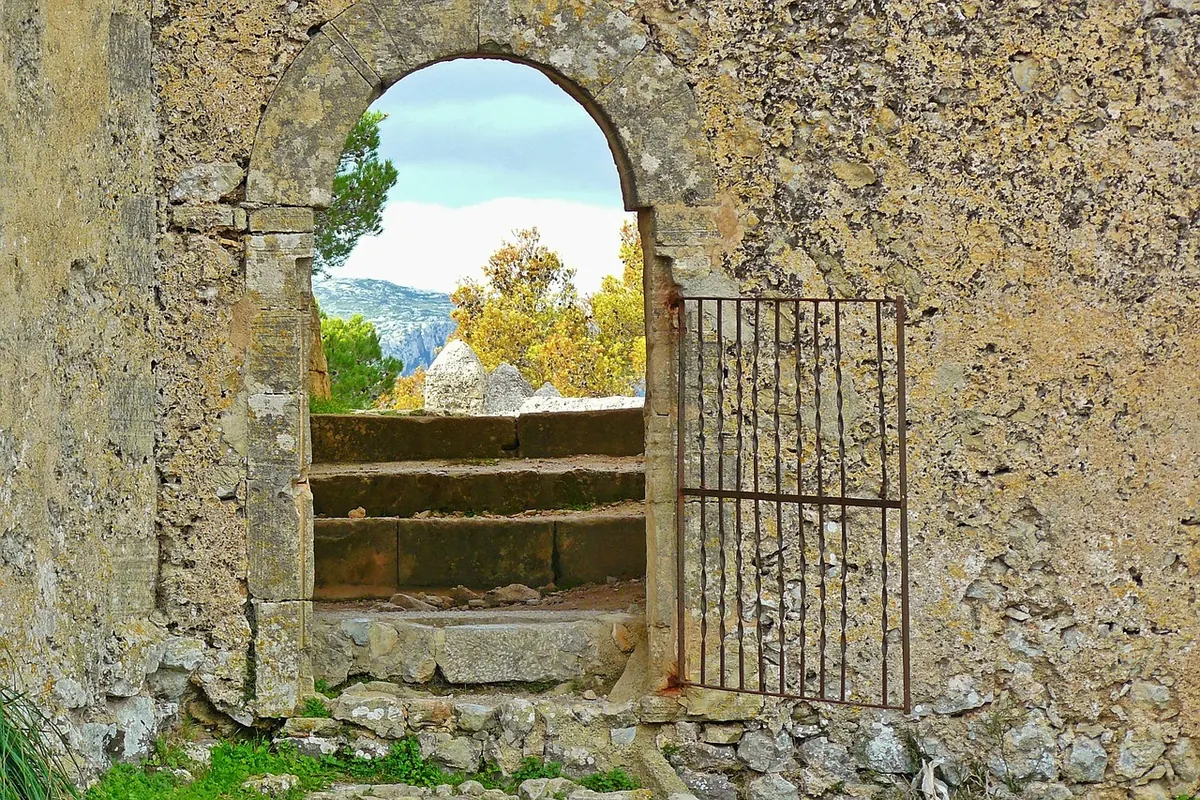
Photograph straight on when the alley allows it. Step back until you can include the whole frame and a little breathing room on each side. Avoid cutting the jambs. Include the details that tell the story of use: the worn stone step, the brass handle, the house number, the bell, the potted geranium, the small tiled roof over the entrance, the letterbox half-hidden by ivy. These details are not decoration; they give scale and evidence of daily life. A door photographed at chest height with a sliver of pavement beneath it says something quite different from the same door cropped tight to its panels.
Exposure needs care. A dark doorway against sunlit plaster will clip at both ends. Expose for the wall and check that the shadow still has some detail, or expose for the interior and let the wall go bright if that is the point. Bracket when unsure. Keep vertical lines vertical, especially with wide lenses; a doorway that leans backward looks careless even in a beautiful alley.
Look for the pattern of doors rather than a single door. In one Ligurian street you may find six entrances in a row, each with the same grey-green stone frame but a different interior darkness, a different number, a different object left outside. Photographed in sequence, they become a kind of typology, and the small differences carry all the interest. That is repetition with variation doing its work.
Wait if someone enters. A figure at the threshold can give scale and a small narrative, but do not direct or block the passage. If no one comes, the door still works. In the edit, place a doorway image where the sequence needs a pause.
Stairs are the street’s pulse. They lead, repeat, divide light, and force the body to move. Photographically they are also difficult: they stack in compression, they throw hard shadows across their own treads, and they invite the dead-centre composition that flattens everything into a grey wedge.
The fix is angle and position. Climb partway up and look back down: the steps become a zigzag of tread and shadow that reads clearly as rhythm. Stand at the bottom and let the stair run diagonally out of the corner of the frame toward a doorway or a patch of sky at the top, and the image gains direction instead of merely describing an object. A landing halfway up is a gift, because it gives the eye somewhere to arrive.
Watch the light. Stairs in shade with a sunlit wall above them are one of the most reliable pictures in a village: the frame holds both cool and warm, near and far, ground and destination. Conversely, a stair fully in sun at midday loses its modelling and becomes a pattern of white lines. If the shadow is too heavy, look for the reflected light bouncing off an opposite wall — it will often lift the risers just enough to keep texture in them.
Details matter here too. Worn centres of treads, a handrail bolted into stone, a bicycle parked against the wall, a cat asleep on the third step, a pot of basil on a landing, a small arch overhead that frames the flight. Keep your verticals straight; a leaning stair reads as an accident. And resist the very wide lens unless you want the exaggeration — it will bend the steps into a fan and make a modest flight look like a monument.
Laundry is the most articulate thing in an Italian village street. It reports on the weather, the hour, the size of a household, and the small theatre of neighbourliness. It is also the element that most quickly turns a competent architectural photograph into a living one.
Look for the whole line, not only the cloth. The story is in the span: a wire from one window to a hook on the opposite wall, a pole propped against a balcony, a pulley sheave rusted into the plaster. Include the window it comes from and the wall it reaches, and you have described a relationship between two buildings rather than a row of garments.
Backlight when you can. Cloth lit from behind glows and becomes translucent, and the shadow the washing throws on the ochre wall behind it is often better than the washing itself. White sheets against a deep blue sky are the obvious version, but the subtler one — a single dark garment and three wooden pegs, sun falling across the fabric at an angle — is the one that will hold its place in a sequence.
Vary your distance. One frame for the alley with the line crossing it; one frame close enough that the pegs and the weave and the wind are legible. Do not linger at a window where someone is working; photograph the street, not the household. If you are noticed, a nod and a lifted camera will usually earn a smile, and sometimes a better picture than the one you were making.
Everything in these streets is doing a job. The photograph’s task is simply to notice the job being done.
The vocabulary looks different depending on when you arrive, and it is worth walking the same two hundred metres at several hours to learn how the street behaves.
Midday is not the enemy. In narrow alleys it produces the deep black thresholds and hard bright plaster that give these scenes their graphic clarity. Expose for the sunlit wall, let the doorways go dark, and the frame will read as shapes rather than surfaces. Early morning is quieter and softer: shutters opening, water on the stones, the first washing going out, the street being swept. Overcast light flattens contrast and is the best condition for doorways and details, because everything at ground level becomes evenly legible.
Rain changes the whole set. Wet stone darkens and reflects, the light turns silvery, and the laundry disappears from the lines — which means your colour motif has to be replaced by something else: an umbrella, a puddle, a striped awning. Go out anyway. A village in rain is the same village with a different voice, and a sequence that includes one wet frame can feel far more like a real walk than twenty sunny ones.
Twelve to twenty frames is a good target for a village walk. Fewer and the repetitions have no chance to register; more and the viewer begins to feel they are being shown everything rather than told something. Edit for rhythm, not for variety of subject.
Open with a frame that establishes the corridor: an alley receding, a slope, a wall with a line of washing across it. Then alternate. An anchor (doorway), a movement (stair), a colour (laundry), another anchor, a detail, a wider frame that shows how two of the motifs sit together. Close on something quiet — a step, a handle, a single peg, a figure turning a corner. Keep a consistent focal length if you can: a set made mostly at 35mm or 50mm feels like one person walking at one pace.
When you edit, ask the same few blunt questions of every frame:
Be willing to drop your favourite picture. The hero shot — the one with the perfect light and the spectacular view — is often the one that breaks the walk, because it belongs to a different set of questions. Coherence is worth more than a single strong frame.
None of this requires special access or special gear. A village will give you doorways, stairs, and washing every morning of the year, and it will not perform for you. You only have to keep looking at the same three things until they start to say something.
Photo: cocoparisienne / Pixabay
A practical checklist for photographing a village festival — from permissions and route scouting to key moments,...
A practical guide to photographing decisive street moments in busy village squares — using shutter speed,...
October 29, 2026 - Local Stories
Copyright © 2026 Sguardi Del Vicolo. All Right Reserved.